
Broadcast bait across the whole yard (dry conditions, evening, no rain coming) and let the workers feed the queen, that kills colonies. Keep a fast mound treatment for the one nest that's an immediate hazard. Skip the folklore. Spring + fall, every year, because Florida never stops sending replacements.
Every Method, Ranked by Biology
Disclosure: links below are affiliate links. If you buy through them we may earn a commission at no extra cost to you. As an Amazon Associate, Mosquito Shield of Boca & Fort Lauderdale earns from qualifying purchases. We only list products consistent with what we'd tell a customer face to face.
Bait for the war, mound treatment for the emergencies. The sprayer is optional, only if you're taking on broader DIY yard treatments.
The Mistakes That Waste the Season
If the yard backs onto a preserve, a canal bank, or an empty lot, understand what you're signing up for: reinfestation pressure is constant, and DIY baiting becomes a permanent seasonal chore. That's the point where our fire ant service (part of Perimeter Pest Control) makes more sense than another Saturday with the spreader, and we're watching for the other Florida ant species while we're there.
Frequently Asked Questions
Why does fire ant bait work better than drenching the mound?
Because the mound you can see is not the colony. Fire ant colonies extend feet underground with a queen (sometimes many queens) the drench rarely reaches, and disturbed colonies simply relocate a few yards away, which is why the mound 'you killed' reappears by the fence. Bait inverts the problem: foraging workers carry a slow-acting toxicant back and feed it through the colony, including the queen. Kill the queen and the colony actually dies instead of moving. Slower to show results than a drench (1–4 weeks), but it's the difference between evicting and exterminating.
What's the best way to apply fire ant bait?
Broadcast, don't spot-treat. Scattering bait lightly across the whole yard hits the colonies you haven't noticed yet, and in Florida there are always colonies you haven't noticed yet. Apply when the ground and grass are dry, no rain expected for 24–48 hours (moisture ruins bait), and when ants are actively foraging: in our summer that means evening, because midday soil is too hot for foragers. A once-in-spring, once-in-fall broadcast is the standard Florida rhythm, with spot bait for stragglers.
When should I use a mound treatment instead of bait?
When a specific mound is an immediate hazard: beside the swing set, at the front door, where the dog runs. An acephate mound treatment (like Ortho Orthene) kills that mound fast. Just know its limits: contact treatments handle the emergency, not the population, and a rattled colony can bud or relocate. The professional pattern is both: broadcast bait as the campaign, mound treatment as the emergency response.
Is fire ant bait safe for dogs and kids in the yard?
Applied per label at broadcast rates, the bait quantity per square foot is tiny, a pound or so spread over a whole yard, and it's formulated to be attractive to ants, not mammals. Standard practice: keep pets and kids off while you apply, water nothing (moisture kills bait attractiveness anyway), and store the bag sealed where the dog absolutely cannot eat it in bulk, because the concentrated bag is a different story from the scattered granules. As always, the label is the law.
Why do fire ants explode after Florida rain?
Two reasons you'll notice mounds after every storm: flooded colonies push up fresh, tall mounds to get above saturated soil, and heavy rain triggers relocation: colonies literally raft and march to higher ground, which is often your yard's well-drained turf. It's also why post-storm weeks are prime bait windows: colonies are re-establishing, foraging heavily, and maximally receptive to a food-source attack. Our fire ant control page covers what our crews do on service properties.
Done Fighting the Yard Yourself?
Perimeter Pest Control covers ants, roaches, spiders and more, $50/month add-on to mosquito service. FL License JB313837. No contracts.
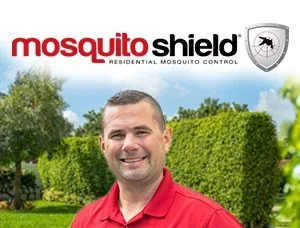
After nearly two decades in corporate finance (most of it at Chico's FAS, where he oversaw operations and finance for 1,000+ retail locations across the US and Canada) Eric Vincent earned his MBA from Rollins College and made a deliberate pivot into pest control, completing his Pest Control Technology degree at the University of Florida while building Mosquito Shield of Boca and Fort Lauderdale from the ground up. He holds five Florida state licenses including Certified Pest Control Operator (JF341961) and Public Health licensee (PH340549), and is currently partnered with Arkion Life Sciences on next-generation all-natural mosquito control research.